
Introduction
Opening an international bank account sounds simple — until you start comparing fees, exchange rates, transfer charges, and regional restrictions.
Many people discover that not all “international” bank accounts are truly global. Some are excellent for Europe but weak in Asia. Others are strong for business banking but expensive for everyday transfers. And many traditional banks still charge hidden foreign exchange markups that quietly increase the real cost of international banking.
That is why Santander International continues to attract attention in 2026.
Santander is one of the largest banking groups in Europe, with a particularly strong presence in the UK, Spain, Portugal, and Latin America. Its international and offshore banking services are designed for expats, global travelers, property owners, and people managing money across different countries.
But is Santander actually good for international banking in 2026?
Can it compete with HSBC, Wise, or Revolut? Is it suitable for freelancers and digital nomads? Or is it mainly designed for traditional banking customers who prioritize stability over low-cost transfers?
In this detailed Santander International Account review, we’ll cover everything you need to know, including account features, supported currencies, transfer fees, exchange rates, hidden costs, security, pros and cons, and who should actually consider using Santander in 2026.
What Is Santander International Account?
Santander International refers to a group of international and offshore banking services offered by Santander through different regional divisions.
Depending on your location, this may include:
- Santander UK International
- Santander Spain international services
- Offshore banking accounts
- Expat-focused banking products
- Multi-currency account options
- International transfer services
These accounts are mainly designed for people who:
- Live abroad
- Travel frequently
- Own property internationally
- Move money between countries
- Manage EUR, GBP, or USD regularly
- Need access to European banking
Unlike fintech apps, Santander operates as a traditional regulated bank.
That means it focuses more on:
- Banking stability
- International account access
- Traditional financial services
- Security and compliance
- Cross-border banking relationships
Rather than trying to become an all-in-one fintech app.
Who Uses Santander International Accounts?
Santander international banking is most commonly used by:
- Expats in Europe
- UK residents with overseas interests
- Spanish property owners
- Frequent travelers
- International retirees
- Businesses trading in Europe or Latin America
- Customers moving between UK and Spain
It is less popular among:
- Freelancers
- Crypto users
- Remote-first fintech users
- Small online sellers
- People focused purely on cheapest FX costs
This distinction matters because Santander is fundamentally a traditional banking institution, not a fintech transfer platform.
Santander’s Global Presence
Santander is strongest in:
- United Kingdom
- Spain
- Portugal
- Brazil
- Mexico
- Chile
- Argentina
Its international strength is heavily concentrated in:
- Europe
- Latin America
Compared with global banks like HSBC or Citibank, Santander has:
- Strong regional depth
- But more limited worldwide retail banking reach
This makes Santander especially attractive for users connected to:
- Spain
- Portugal
- UK-Europe financial movement
- Latin American banking corridors
However, it is less competitive for users needing strong banking access in:
- Asia
- Middle East
- Africa
Santander Multi-Currency Features
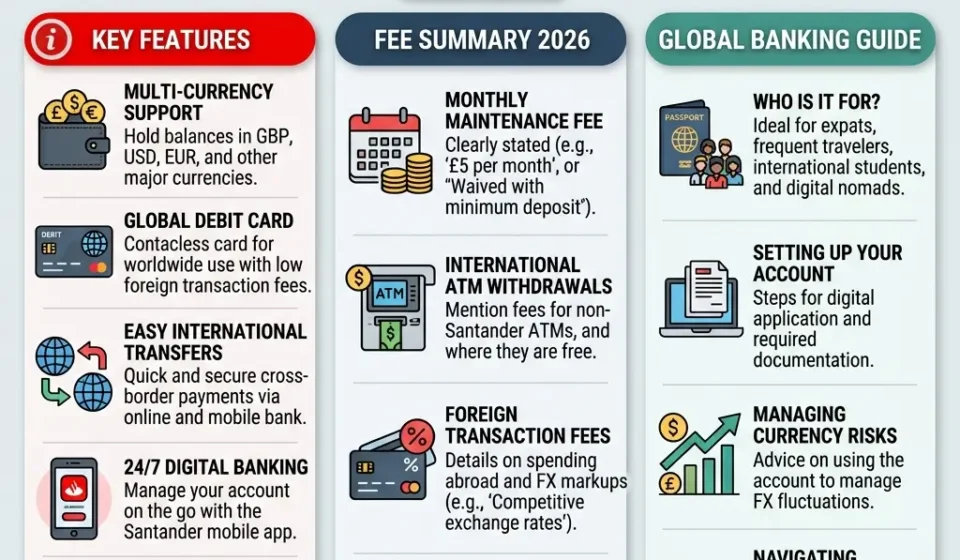
Santander does offer foreign currency and international account capabilities, but they are not as flexible as fintech platforms like Wise or Revolut.
The bank mainly focuses on major currencies and traditional international banking services.
Typical features include:
- Holding major currencies
- International transfers
- Foreign currency payments
- Debit card access
- Online banking
- Currency exchange inside banking system
However, Santander is not designed to function like a full multi-currency fintech wallet.
For example:
Wise supports 40+ currencies with flexible balance management.
Santander usually focuses more on:
- EUR
- GBP
- USD
- Selected major currencies
This is perfectly fine for many expats and international banking users, but less attractive for people needing advanced global currency management.
Supported Currencies
The exact currencies available may depend on:
- Country
- Account type
- Santander region
- Customer status
The most common supported currencies include:
- EUR
- GBP
- USD
Some regions may support additional currencies, but Santander generally remains more limited than fintech competitors.
This is one of the key differences between:
- Traditional international banks
vs - Modern multi-currency fintech apps
Main Advantage: Traditional Banking Stability
Santander’s biggest strength is not necessarily cheap transfers.
Its main advantage is traditional banking stability.
For many users, that matters a lot.
Some people prefer:
- Physical banking presence
- Established reputation
- Banking regulation
- Long-term account relationships
- Mortgage access
- Traditional banking infrastructure
Santander delivers those things far better than most fintech platforms.
This is especially important for:
- Expats buying property
- International retirees
- Wealth management users
- People needing long-term European banking
Santander International Account Fees in 2026
Fees are one of the most important parts of this review.
Santander is generally not the cheapest international banking option available.
Like many traditional banks, the total cost often includes:
- Account charges
- FX margins
- Transfer fees
- Intermediary bank charges
- ATM fees
That’s why users should focus on the full cost, not just advertised fees.
1. Account Opening Fee
Opening a Santander international account is usually free in many cases.
However, some account types may require:
- Initial deposit
- Eligibility checks
- Residency verification
- Relationship banking requirements
Offshore or premium accounts may involve different conditions.
2. Monthly Maintenance Fees
Monthly account fees vary depending on:
- Country
- Account type
- Minimum balance
- Banking package
Some accounts may have:
- No monthly fee
if conditions are met.
Others may charge:
- Monthly maintenance costs
if minimum balances are not maintained.
This is common among traditional banks.
Fintech alternatives often feel cheaper because they avoid many of these legacy account structures.
3. International Transfer Fees
Santander international transfers are usually more expensive than fintech platforms like Wise.
Costs may include:
- Transfer fee
- Receiving bank fee
- SWIFT fee
- Intermediary charges
- Currency conversion margin
Transfers within Santander’s own banking network may be:
- Faster
- Cheaper
- Or sometimes free
However, external international bank transfers often involve multiple fee layers.
This is one of the biggest differences between traditional banks and modern fintech services.
4. Currency Conversion Fees
Currency conversion is usually the biggest hidden cost.
Santander generally applies:
- An exchange rate markup
This means the rate offered is usually less favorable than the true mid-market exchange rate shown on Google.
For large international transfers, this can become expensive.
Example:
A 1%–3% exchange rate difference on a large transfer can cost hundreds or thousands.
This is why many international users now compare Santander with Wise before sending money abroad.
5. ATM Fees
ATM costs depend heavily on:
- Country
- Account type
- Network usage
- Premium account status
Inside Santander networks, ATM withdrawals may be free or cheaper.
Outside those networks:
- International ATM charges may apply
- Foreign exchange charges may apply
- Local ATM fees may apply
Premium accounts often provide better international withdrawal benefits.
Hidden Costs Most Users Ignore
This is where many users underestimate the real cost of international banking.
The biggest hidden expenses often include:
FX Margin
This is usually more expensive than the visible transfer fee.
Cross-Border Charges
International payments may trigger additional banking network costs.
Monthly Account Fees
Traditional banking accounts often involve ongoing maintenance charges.
Intermediary Bank Fees
SWIFT transfers sometimes lose money through intermediary deductions.
Foreign ATM Costs
International cash withdrawals can become expensive.
Santander Transfer Speed
Transfer speed depends on:
- Currency
- Country
- Banking hours
- SWIFT routing
- Santander network access
Typical timing:
- Santander internal transfers: same day or next day
- International SWIFT transfers: 1–4 business days
Compared with fintech platforms:
- Wise is often faster
- Revolut may feel more instant
- Santander prioritizes traditional banking processing
For business and larger regulated transactions, some users may actually prefer traditional processing stability.
Transfer Limits
Santander generally supports:
- Moderate to high transfer limits
Limits depend on:
- Account type
- Verification level
- Banking relationship
- Country regulations
Premium and international banking clients may receive:
- Higher limits
- Faster processing
- Better support
This makes Santander more suitable for established banking customers than casual transfer users.
Santander Mobile App Experience
Santander’s mobile app is functional and secure, but less advanced than fintech apps.
Users can:
- Check balances
- Send transfers
- Track spending
- Receive alerts
- Manage cards
- Monitor account activity
Compared with Revolut or Wise:
- Santander feels more traditional
- Less feature-heavy
- Less app-centric
However, for many users, simplicity and stability are perfectly acceptable.
Is Santander Safe?
Yes — Santander is considered very safe.
It is one of Europe’s largest banking groups and operates under strict financial regulation in multiple countries.
Security features include:
- Fraud monitoring
- Banking encryption
- Secure login systems
- Regulatory protections
- Customer authentication systems
For users moving larger amounts internationally, Santander’s institutional reputation is a major advantage.
This is one reason some customers still prefer traditional banks over fintech-only platforms.
Santander vs Wise
Wise is one of Santander’s biggest competitors for international transfers.
Wise is usually better for:
- Lowest fees
- Transparent exchange rates
- Multi-currency flexibility
- Freelancers
- Remote workers
- Smaller international payments
Santander is usually better for:
- Traditional banking
- European banking relationships
- Expats
- Property owners
- Long-term account stability
Wise wins on cost efficiency.
Santander wins on traditional banking infrastructure.
Santander vs HSBC
HSBC is much more globally diversified than Santander.
HSBC is stronger for:
- Asia access
- Global banking
- International business banking
- Worldwide account networks
Santander is stronger for:
- Spain and Latin America connections
- UK-Spain banking
- European regional banking
If your life or business is connected heavily to Europe or Latin America, Santander may feel more relevant.
Santander vs Revolut
Revolut offers:
- Better app experience
- More currencies
- Faster onboarding
- Lower FX costs
- More fintech features
Santander offers:
- Traditional banking stability
- Physical presence
- Established banking trust
- Conventional banking services
Revolut is more flexible.
Santander is more conservative and bank-focused.
Who Should Use Santander International Account?
Santander is best for a specific type of customer.
Best For
Expats in Europe
Especially users connected to UK or Spain.
EUR and GBP Users
Good for people primarily managing European currencies.
Property Owners Abroad
Useful for international property banking relationships.
Frequent Travelers in Europe
Especially within Santander-supported regions.
Traditional Banking Customers
Ideal for users who prioritize bank stability over fintech flexibility.
Who Should Avoid Santander?
Santander is not ideal for everyone.
Not Best For
Freelancers
Wise or Payoneer may be cheaper and simpler.
Users Needing Many Currencies
Fintech apps usually offer broader currency support.
Cost-Sensitive International Users
Santander’s FX margins may feel expensive.
Users Outside Europe and Latin America
Santander’s strongest network is regional.
People Wanting Lowest Transfer Costs
Wise usually remains cheaper for international transfers.
How to Open a Santander International Account
Opening an account usually involves:
- Choosing your Santander region
- Completing an online or branch application
- Providing identification
- Verifying address and residency
- Funding the account
- Activating online banking and cards
Some international and offshore accounts may allow remote onboarding depending on jurisdiction and eligibility.
However, traditional bank verification is usually stricter than fintech onboarding.
Santander International Account Pros and Cons
Pros
Strong European Banking Presence
Very useful for UK and Spain-linked banking.
Trusted Traditional Bank
Large institutional reputation and regulation.
Good for EUR and GBP Transactions
Useful for regional international banking.
Stable Banking Infrastructure
Good for long-term banking relationships.
Reliable International Services
Especially for established customers.
Cons
Exchange Rate Markup
Usually not as cheap as Wise.
Monthly Fees
Some accounts require maintenance charges.
Limited Currency Flexibility
Not as broad as fintech multi-currency platforms.
Less Global Than HSBC
Stronger regionally than globally.
Traditional Banking Complexity
Processes may feel slower than fintech apps.
Final Verdict: Is Santander International Account Worth It in 2026?
Yes — for the right user.
Santander International can be an excellent option if:
- You live in Europe
- You move between UK and Spain
- You need a stable traditional bank
- You value banking reputation and security
- You regularly use EUR or GBP
- You prefer traditional banking relationships
However, Santander is not the cheapest or most flexible international banking solution.
If your top priority is:
- Lowest fees
- Mid-market exchange rates
- Multi-currency flexibility
- Fast fintech-style transfers
Then Wise or Revolut may be better choices.
The easiest way to think about Santander is this:
Santander is strongest as a regional international bank for Europe and Latin America. Wise is strongest for cheap global transfers. HSBC is strongest for worldwide banking reach. Revolut is strongest for fintech flexibility and app experience.
For expats, international property owners, and users already connected to Santander regions, the account can still provide solid value in 2026.