
Introduction
Managing money internationally is no longer a luxury. For many people, it is now part of everyday financial life.
You may be an expat living abroad, a business owner paying overseas suppliers, a freelancer receiving global income, a frequent traveler, or an investor managing money across different countries. In all of these cases, the bank account you choose can affect your costs, convenience, security, and access to your money.
One name that often appears in international banking discussions is Citibank.
Citibank is one of the most recognized global banking brands, known for premium services such as Citigold, International Personal Banking, global transfers, wealth management, and multi-currency account access in selected markets.
But is Citibank still a good international banking option in 2026?
The answer depends heavily on your profile.
Citibank can be excellent for high-balance customers, expats, investors, and users who want premium global banking services. But for freelancers, low-balance users, and people who simply want the cheapest international transfers, fintech platforms like Wise may offer better value.
In this detailed Citibank International Account review, we’ll break down fees, features, multi-currency options, transfer speed, hidden costs, pros and cons, and how Citibank compares with HSBC and Wise.
What Is a Citibank International Account?
A Citibank International Account is not one single product. Instead, it usually refers to a group of Citi banking services designed for customers who need cross-border banking, multi-currency access, premium account management, and international money movement.
Depending on your country, Citibank international banking may include:
- Citigold
- Citigold Private Client
- International Personal Bank
- Multi-currency accounts
- Global currency accounts
- Citi Global Transfers
- Offshore or cross-border banking services
- Wealth and investment-linked banking
Citibank’s international banking services are generally aimed at customers with more complex financial needs than a basic checking account user.
That includes:
- Expats
- High-net-worth individuals
- International investors
- Business owners
- Frequent travelers
- People with assets in multiple countries
- Customers who need global wealth management
This is important because Citibank is not always the best choice for small, casual international transfers. Its strongest value appears when you use the full premium banking ecosystem.
Is Citibank a Real Global Bank?
Yes. Citibank is part of Citi, one of the world’s major financial institutions. Citi describes itself as a global bank serving institutions with cross-border needs, a global provider in wealth management, and a U.S. personal bank. (Citi)
Citibank has historically been one of the most internationally recognized banking brands. However, its consumer banking presence has changed in some countries over time, so availability depends heavily on your region.
This means Citibank may be very strong in one market but less accessible in another.
Before opening an account, always check your local Citi website or regional International Personal Bank page.
Citigold and Premium Banking
One of Citibank’s most important international banking products is Citigold.
Citigold is designed for customers who maintain a high combined balance across eligible deposit, retirement, and investment accounts. Citi states that the Citigold Relationship Tier is designed for clients who maintain a combined average monthly balance of at least $200,000 in linked eligible accounts. (Citigold)
This is why Citibank is often described as a premium banking option.
Citigold customers may receive benefits such as:
- Relationship manager access
- Wealth management services
- Fee waivers
- Global banking support
- Investment access
- Higher transaction limits
- Better service levels
- International banking privileges
For customers who already maintain high balances, Citigold can be valuable.
For low-balance users, the account may be too expensive or unnecessary.
Citigold Private Client
Citigold Private Client is a higher-tier relationship for wealthier customers.
Citi says Citigold Private Client is designed for customers who plan to sustain a combined average monthly balance of $1,000,000+ in eligible accounts. (Citigold Private Client)
This tier is not intended for everyday users. It is designed for wealthy clients who need deeper wealth management, investment services, banking support, and premium financial planning.
If you are looking for a simple international transfer account, this is likely more than you need.
Citibank International Personal Banking
Citibank International Personal Banking, often called IPB, is designed for customers who live internationally or manage money across borders.
For example, Citi’s International Personal Bank in Singapore states that a monthly service fee of US$50 applies if the balance falls below a monthly average minimum balance of US$200,000 or equivalent. (Citibank IPB)
That single detail tells you a lot about Citibank’s positioning.
This is not mainly a low-cost fintech account. It is a premium international banking solution for customers who can meet high balance requirements.
Citibank Multi-Currency Account Features
Citibank offers multi-currency banking features in selected markets.
The exact number of supported currencies depends on your region and account type.
For example, Citi UAE says its offshore multi-currency account lets customers manage money in 21 different currencies, and Citi Global Transfer can allow instant, transaction-fee-free transfers between Citibank accounts in more than 20 countries. (Citibank UAE)
Citi Hong Kong says its multi-currency account offers up to 12 currency choices, including AUD, CAD, CHF, EUR, GBP, HKD, JPY, NZD, RMB, SGD, THB, and USD. (Citibank Hong Kong)
This makes Citibank useful for users who regularly hold major currencies such as:
- USD
- EUR
- GBP
- AUD
- CAD
- JPY
- SGD
- CHF
- HKD
However, Wise still supports more currencies overall for everyday multi-currency use.
What Can You Do With a Citibank International Account?
Depending on your country and account type, Citibank international banking may allow you to:
- Hold multiple currencies
- Send international transfers
- Receive money from abroad
- Access global ATMs
- Move money between Citi accounts
- Manage investments
- Track foreign exchange rates
- Use relationship banking services
- Access wealth management tools
- Maintain accounts in different jurisdictions
This makes Citibank more comprehensive than a simple money transfer app.
However, that extra depth comes with more complexity, higher balance requirements, and potentially higher costs.
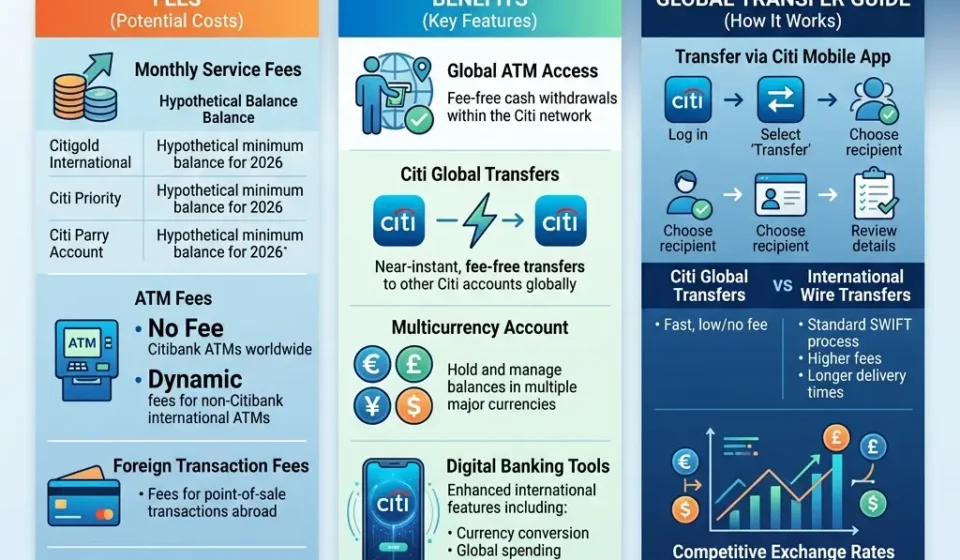
Citibank International Account Fees in 2026
Fees are where most users need to pay close attention.
Citibank can be convenient and powerful, but it is not always cheap.
The total cost may include:
- Monthly service fees
- Minimum balance requirements
- International transfer fees
- SWIFT or intermediary charges
- Exchange rate margins
- ATM fees
- Account tier requirements
Let’s break this down clearly.
1. Account Maintenance Fees
Citibank fees depend on your country, account package, and relationship tier.
For Citigold in the U.S., Citi says monthly service fees are waived for customers in Citigold Private Client, Citigold, or Citi Priority Relationship Tiers during the calendar month. (Citi)
However, premium tiers require customers to maintain qualifying balances. If you do not meet those requirements, your account may be re-tiered or fees may apply.
For International Personal Bank Singapore, Citi states that a US$50 monthly service fee applies if the average monthly balance falls below US$200,000 or equivalent. (Citibank IPB)
This makes Citibank best for users who can comfortably maintain high balances.
2. Minimum Balance Requirements
This is one of Citibank’s biggest barriers.
Citigold commonly requires around $200,000 in combined eligible balances. (Citigold)
Citigold Private Client is designed for customers with $1 million or more in eligible balances. (Citigold Private Client)
These thresholds make Citibank very different from Wise, Revolut, Payoneer, or N26.
If you are a freelancer receiving $1,000–$3,000 per month, Citibank may not be the most practical choice.
If you are an investor, executive, expat, or business owner with significant funds, Citibank becomes more relevant.
3. International Transfer Fees
Citibank offers several international transfer options.
One of its strongest features is Citi Global Transfer, which allows eligible Citi customers to send money between Citi accounts in different countries.
Citi says if a Citibank Global Transfer is made in foreign currency, the exchange rate includes a commission for currency conversion, and transfer limits apply. (Citi)
This means even if a transfer appears fee-free, there may still be a cost inside the exchange rate.
For external international transfers, additional fees may apply, including:
- Outgoing wire fees
- Intermediary bank fees
- Recipient bank fees
- Currency conversion margin
That is why users should compare the total cost, not just the visible transfer fee.
4. Currency Conversion Fees
This is one of the most important hidden costs.
Citibank may offer market-based exchange rates, but foreign currency conversion usually includes a bank margin or commission.
Citi’s own Global Transfer information states that foreign currency transfers include a commission in the exchange rate. (Citi)
This is typical for traditional banks.
The problem is that users often focus on “free transfers” while ignoring the exchange rate margin.
For example, a transfer might have no upfront fee but still cost more than Wise because of a less favorable FX rate.
5. ATM Fees
ATM fees depend on your account tier and country.
Citi says there is no charge for cash withdrawals with a Citibank Banking Card at proprietary Citibank ATM locations in the U.S., while a $2.50 Non-Citi ATM fee applies at certain non-Citi ATMs unless waived for eligible relationship tiers such as Citigold, Citigold Private Client, or Citi Priority. (Citi)
Premium users often receive better ATM benefits.
Standard users may pay more, especially outside Citi’s network.
Hidden Costs You Should Know
Citibank’s international banking can look attractive, especially when Citi-to-Citi transfers are free or fast.
But hidden costs may still apply.
1. Exchange Rate Markup
This is often the biggest cost.
Even if a transfer has no visible fee, the currency conversion rate may include Citi’s margin.
2. Intermediary Bank Fees
External SWIFT transfers may pass through other banks, and those banks may deduct fees.
3. Balance Requirements
Premium benefits often require high balances.
If you fall below the required balance, monthly fees may apply or benefits may reduce.
4. Regional Differences
Citibank products vary significantly by country.
A feature available in Singapore may not be identical to a feature in the U.S., UAE, or Hong Kong.
5. Account Complexity
Citibank’s international services can be more complex than fintech apps.
That complexity may be worth it for wealthy customers, but unnecessary for simple transfers.
Citibank Transfer Speed
Citibank transfer speed depends on the transfer type.
Citi-to-Citi Transfers
Citi Global Transfers can be instant or same day when available between eligible Citi accounts.
This is one of Citibank’s strongest international features.
External International Transfers
External transfers usually take:
- 1–3 business days
- Sometimes longer depending on country, currency, and compliance checks
Compared with Wise, Citibank may be faster for Citi-to-Citi movement but not always cheaper for external international transfers.
Citibank Transfer Limits
Citibank generally offers higher transfer limits than many fintech apps, especially for premium clients.
Limits depend on:
- Country
- Account type
- Relationship tier
- Verification status
- Transfer method
- Destination country
This makes Citibank suitable for:
- Large international transfers
- Wealth movement
- Business payments
- Property-related transfers
- Investment funding
For small transfers, Wise or Revolut may be simpler and cheaper.
Citibank Mobile Banking Experience
Citibank’s app and online banking tools allow users to:
- View balances
- Send transfers
- Manage cards
- Track investments
- Monitor foreign currency accounts
- Access Citi Global Transfer where available
- Review transaction history
The app is strong compared with many traditional banks.
However, it may not feel as smooth or modern as Revolut or Wise.
Citibank’s digital experience is built around banking depth, not fintech simplicity.
Is Citibank Safe?
Yes. Citibank is considered one of the most trusted banking names globally.
Its safety advantages include:
- Strong banking regulation
- Fraud monitoring
- Secure online banking
- Global institutional reputation
- Bank-grade encryption
- Customer authentication systems
For high-value users, Citibank’s security and reputation are major reasons to choose it over smaller fintech platforms.
However, “safe” does not automatically mean “lowest cost.”
Citibank may be secure and globally recognized, but Wise may still be cheaper for standard international transfers.
Citibank vs Wise
Wise is usually the better option for low-cost international transfers.
Wise Is Better For:
- Lower fees
- Transparent pricing
- Mid-market exchange rates
- Freelancers
- Remote workers
- Small businesses
- Users sending regular international payments
Citibank Is Better For:
- Premium banking
- High-balance users
- Wealth management
- Citi-to-Citi transfers
- Global banking relationships
- Larger transactions
The main difference is simple:
Wise is built for cheap international money movement. Citibank is built for premium international banking.
Citibank vs HSBC
HSBC is probably Citibank’s closest traditional banking competitor.
Both banks serve international users, expats, investors, and high-value customers.
Citibank Strengths
- Strong premium banking
- Citi Global Transfer network
- Wealth management integration
- Strong U.S. banking identity
HSBC Strengths
- Broader international banking reputation
- Strong Asia and UK presence
- Strong expat banking options
- Global account opening support in many regions
If you want a traditional global bank, both are strong options.
HSBC may feel more globally balanced, while Citibank may be stronger for customers already connected to Citi’s premium banking ecosystem.
Citibank vs Revolut
Revolut is very different from Citibank.
Revolut is better for:
- Travel spending
- App-based banking
- Currency exchange convenience
- Budgeting tools
- Everyday multi-currency use
Citibank is better for:
- Premium banking
- Wealth management
- High transfer limits
- Traditional banking trust
- Larger balances
Revolut is more modern.
Citibank is more institutional.
Who Should Use Citibank International Account?
Citibank is best for specific customers.
High-Net-Worth Individuals
If you can meet Citigold or Citigold Private Client requirements, Citibank can be valuable.
Expats
Citibank can help users who live internationally and need cross-border banking.
Investors
The combination of banking and wealth management is useful.
Business Owners
High transfer limits and global account access may be valuable.
Frequent International Travelers
ATM and global banking benefits can help, especially for premium users.
Who Should Avoid Citibank?
Citibank is not ideal for everyone.
Low-Balance Users
Minimum balance requirements may be too high.
Freelancers Wanting Cheap Transfers
Wise or Payoneer may be better.
Beginners
Citibank’s international banking structure can feel complex.
Small Transfer Users
The costs may not make sense for small payments.
Users Wanting Simple Fintech Apps
Wise, Revolut, or N26 may feel easier.
How to Open a Citibank International Account
The opening process depends on your country and account type.
Typical steps include:
- Choose your account type
- Check minimum balance requirements
- Apply online or visit a Citi branch
- Submit identity documents
- Provide proof of address
- Complete compliance checks
- Fund the account
- Activate mobile banking and international transfer features
Some regions allow online onboarding.
Premium accounts may require relationship manager contact.
Citibank International Account Pros and Cons
Pros
Strong Global Brand
Citibank is one of the most recognized banking names worldwide.
Premium Banking Services
Citigold and Citigold Private Client offer strong benefits for wealthy customers.
Multi-Currency Access
Selected markets support multiple currency accounts.
Citi Global Transfers
Citi-to-Citi transfers can be fast and convenient where available.
High Transfer Limits
Useful for large transactions and international wealth movement.
Wealth Management Integration
Good for investors and high-net-worth users.
Cons
High Minimum Balance Requirements
Citigold is designed around significant balances, commonly $200,000+. (Citigold)
Not the Cheapest Option
Wise is usually cheaper for standard international transfers.
FX Margin Applies
Citi Global Transfer exchange rates can include a commission for currency conversion. (Citi)
Regional Differences
Products and fees vary by country.
Not Beginner-Friendly
The account structure may be too complex for simple users.
Final Verdict: Is Citibank Worth It in 2026?
Yes — but mainly for premium users.
Citibank International Banking can be a strong choice if you:
- Maintain high balances
- Need global banking access
- Want premium relationship banking
- Travel frequently
- Manage investments internationally
- Need higher transfer limits
- Already use Citi’s banking or wealth services
However, Citibank is not the best option if your main goal is low-cost international transfers.
For freelancers, students, remote workers, and small online businesses, Wise or Revolut may be cheaper and easier.
The simplest way to think about it is this:
Citibank is best for premium global banking. HSBC is best for broad international banking reach. Wise is best for cheap transfers. Revolut is best for travel and app-based finance.
If you are a high-balance customer, Citibank can be powerful. If you are a cost-sensitive user sending smaller international payments, fintech platforms will usually provide better value.